Verify Loewe Scarf Shipping Volume, Weight, and Cost
- Topic
- general
If you're planning to find a Loewe scarf through fashion-reps and hand the order off to an external shopping agent, the easiest place to go wrong isn't usually the listed price—it's using inconsistent metrics for packaging volume, billable weight, shipping line fees, and currency conversion. This guide helps you build a verifiable cost record before placing your order, so you can make informed decisions at warehouse intake, after packaging adjustments, and before submitting the international shi
If you're planning to find a Loewe scarf through fashion-reps and hand the order off to an external shopping agent, the easiest place to go wrong isn't usually the listed price—it's using inconsistent metrics for packaging volume, billable weight, shipping line fees, and currency conversion. This guide helps you build a verifiable cost record before placing your order, so you can make informed decisions at warehouse intake, after packaging adjustments, and before submitting the international shipping waybill. 📦
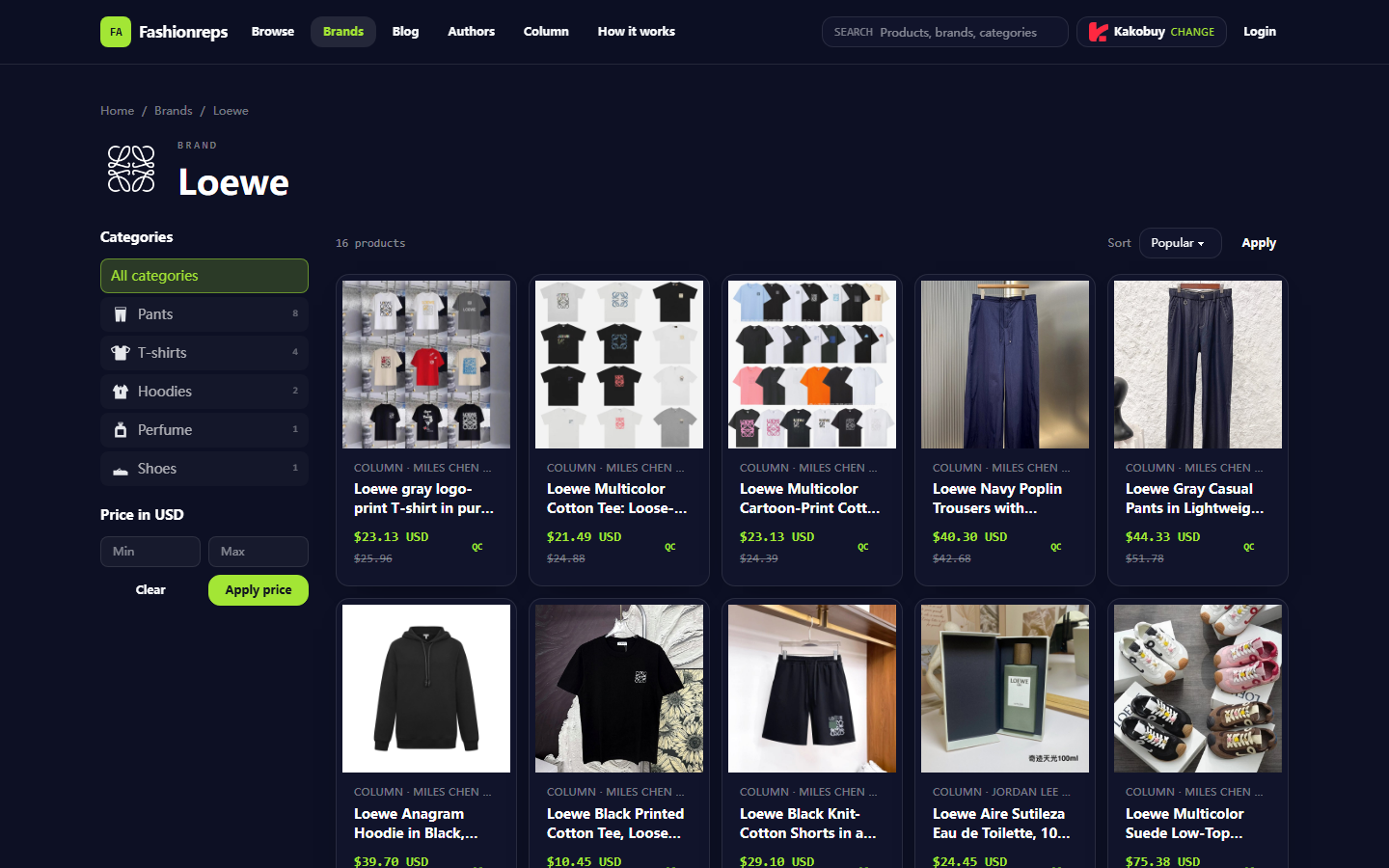
This article does not provide real-time verified prices, stock, weight, or shipping figures. The current sample only includes a screenshot of fashion-reps' Loewe brand catalog, with no verifiable Loewe scarf product page, measured packaging data, or destination agent quote. Therefore, these items are marked as fields to be verified. You should rely on the actual product page, warehouse weighing results, and the official shipping calculator of your chosen agent.
Clarifying the cost verification task for shipping Loewe scarves overseas
The specific problem you need to solve is: once a Loewe scarf arrives at the warehouse, should it be billed by actual weight or volumetric weight? Which protective packaging should you keep? Should you combine shipping or send separately? And how much will you pay in your local currency?
After reading, you should be able to complete four actions:
- Record consistent conditions for the item, packaging, and destination.
- Confirm actual weight, volumetric weight, and final billable weight using the agent's official tools.
- Organize product price, agent service fee, payment fees, packaging fees, international shipping, taxes, and exchange rate into separate columns.
- Before submitting the order, decide whether to keep original packaging, adjust packaging, combine shipping, or split shipping based on cost savings versus new risks.
This guide does not apply if: you haven't determined the destination country or region, there's no accessible product page, the warehouse hasn't provided weight or dimensions, the agent's tool requires login and you can't view quotes, or you intend to bypass declaration, taxes, or import inspection. Compliant declaration cannot be replaced by under-declaring, splitting shipments to avoid taxes, or hiding item information. 🧾

Recording style, color, size, and visible packaging info from the fashionreps product page
Always open the actual Loewe scarf product page, not just the brand catalog. fashion-reps' brand catalog can help you locate the item, but the catalog sample shows clothing, shoes, and fragrances—it doesn't prove a specific scarf exists, and the reference prices in the catalog are not the scarf's price.
The product page should record at least the following:
- Product title and product page URL.
- Style, color, size, or length options.
- Material, packaging, accessories, and seller information shown on the page.
- Price, currency, and time of inquiry displayed on the page.
- Whether multiple colors or sizes exist, and if different options might affect weight.
- Whether the page loads normally, with a clear product name and enough visible information.
If the product page is inaccessible, redirects, only shows tag content, or lacks sufficient information to support writing and ordering decisions, mark the item as "to be verified" and do not fabricate price, material, inventory, or packaging details.
Packaging information here can only be what the page explicitly shows. For example, if the page only shows the scarf itself, you cannot assume it includes a gift box, brand bag, rigid cardboard box, or dust bag. Product images help identify what's displayed, but they don't prove you've felt the material, inspected the craftsmanship, or confirmed the actual packaging weight.
Standardizing destination, item quantity, packaging condition, and inquiry time
Cost comparison requires fixed conditions. At minimum, standardize these variables:
- Destination country, state/province, and postal code; different regions may have different shipping lines and tax rules.
- Item quantity; one scarf and multiple scarves cannot share the same billing conclusion.
- Item condition; whether it's just arrived, outer packaging removed, or already repacked.
- Whether combined shipping is used; combining may reduce repeated first weight but could increase volumetric weight.
- Agent account, warehouse, and selected shipping line; quotes from different agents or lines cannot be mixed.
- Currency and inquiry time; prices, exchange rates, taxes, and line availability are time-sensitive.
It's recommended to save screenshots or exported quote records for every inquiry, and note "query date, destination, line name, quote validity conditions." If the quote tool doesn't state whether taxes are included, mark tax status as "unconfirmed" rather than assuming included or excluded.
A ready-to-use record table:
| Cost Field | What to Record | Verification Basis |
|---|---|---|
| Product Price | Amount, currency, options shown on product page | Actual product page |
| Agent Service Fee | Service fee and billing method shown in agent tools | Agent official fee page or checkout |
| Payment Fees | Payment method, handling fees, or exchange margin notes | Payment page or statement |
| Packaging Fee | Costs for reinforcement, box replacement, outer packaging removal | Warehouse value-added service page |
| International Shipping | Line, billable weight, destination, and quote | Agent official shipping calculator |
| Taxes | Whether prepaid, collected by whom, applicable conditions | Line description and destination country rules |
| Exchange Rate | Source, time, and conversion direction | Payment page or reliable rate source |
What volume and weight fields to record when keeping or adjusting protective packaging
Don't just ask "how much does this scarf weigh?" International shipping may involve both actual and volumetric weight, with the rule determined by the line and agent. You should obtain these fields from the warehouse or agent tools:
- Actual weight of the item.
- Actual weight after packaging.
- Length, width, and height of the outer box.
- The volumetric weight formula and divisor used by the agent.
- Whether calculations use centimeters and kilograms.
- Whether there is a minimum billable weight, rounding rules, or first/additional weight rules.
- The final billable weight used.
- Data sets before and after packaging adjustments.
If the tool shows both actual and volumetric weight, confirm whether the line takes the higher value, rounds by intervals, or uses another rule. If the formula isn't visible, don't apply common volumetric divisors found online, as different lines may differ.
Packaging adjustments should be evidence-based. If the scarf itself is light but a large rigid box significantly increases outer box dimensions, ask the warehouse to provide separate dimensions and weights for "original packaging" and "adjusted packaging." If removing the gift box may lower cost but increases risk of wrinkling, squashing, moisture, or damage to gift condition, record these risks in your decision.
When keeping packaging is appropriate
Situations where keeping original packaging is usually suitable:
- You need gift completeness, or the product page clearly shows packaging is part of the purchase.
- Warehouse photos show the packaging provides protection, and removing it may increase transit damage risk.
- Keeping packaging won't push volumetric weight into a higher billing tier.
- Destination and line have no additional restrictions on such packaging.
When adjusting packaging is appropriate
Situations where adjusting packaging can be considered:
- You don't need the gift box or display packaging.
- The warehouse can provide before/after dimensions, weight, and service fees.
- Adjustments won't weaken moisture, compression, or folding protection.
- The agent's tool shows savings that cover the packaging service fee and potential risks.
Don't decide to remove the box just because it "looks smaller." Recalculate using warehouse-measured data and keep before/after evidence. 🔍
Checking line, billable weight, shipping cost, and tax terms in the agent's official shipping calculator
The fashion-reps page states that purchases redirect to your chosen shopping agent, and orders, payments, and shipping are handled on the agent's site. Therefore, fashion-reps reference info cannot replace the agent's real-time international shipping quote. In your actual agent account, complete these checks:
- Confirm the item is in the warehouse, or at least has an agent-approved estimated weight.
- Select the exact destination country, region, and postal code.
- Enter item quantity, packaging condition, and combined shipping status.
- Review line name, estimated billable weight, and billing unit.
- Check whether international shipping includes fuel surcharge, remote area fee, insurance, or other add-ons.
- Check whether taxes are prepaid, collect on delivery, collected by carrier, or not included at all.
- Save the quote time, line conditions, and final settlement amount.
If the agent only provides an estimate, label it as "estimated," not final cost. If billable weight changes after warehouse weighing, re-query. Line limits, prohibited items, declaration requirements, and destination import rules must be confirmed separately. Especially, don't assume a line accepts or rejects an item just because the product name contains a brand name.
For combined shipping, compare at least two options: one scarf shipped alone, and combined with other warehouse items in the same batch. When comparing, record total billable weight, total dimensions, packaging fees, shipping cost, tax terms, and single-package loss risk. Combining may lower repeated first weight or handling costs, but may also increase declared value, volumetric weight, and single-loss risk. Splitting may add fixed fees but sometimes solves route restrictions or reduces per-package risk.
How to record exchange rate, payment fees, service fees, and international shipping in separate columns
Don't treat the total on the agent's checkout page as "shipping cost" alone. Break it down into at least these layers:
- Product price: actual amount shown on the product page.
- Agent service fee: purchasing, handling, or other service charges.
- Warehouse service fee: inspection, photography, reinforcement, repackaging, or other value-added services.
- International shipping: transport cost determined by line, destination, and billable weight.
- Taxes: confirmed as included or not based on line and destination rules.
- Payment fees: charges from payment channel, card network, wallet, or account.
- Exchange rate cost: difference between the payment platform's rate and a public reference rate.
It's recommended to save amounts in original currency and converted local currency separately. When converting, note "original currency, target currency, rate source, query time, whether payment platform markup included." If the final charge on your payment method differs from the agent's checkout amount, reconcile the difference against your statement and mark it as "to be explained" rather than averaging it into product or shipping costs.
You can use the following framework, but only calculate the total after all inputs are verified:
Total expense = Product price + Agent service fee + Warehouse packaging service fee + International shipping + Confirmed taxes + Payment fees
Local currency expense = Original currency total × Actual exchange rate used
If taxes, payment fees, or exchange rate are not determined, keep them as "to be verified" and don't fill in guess numbers. 💱
How to turn the page into a staged verification process when real-time weight or rates are missing
Not having real-time packaging weight on the product page doesn't mean you can't proceed—it means you should structure the article and decision-making as a phased verification process:
- Product page stage: record only product name, options, price, currency, and page time; do not write international shipping.
- Warehouse intake stage: request warehouse-measured weight, outer box dimensions, and item photos; confirm packaging condition.
- Quote stage: enter destination and billing data into the chosen agent's official tool; record line and quote.
- Settlement stage: recheck service fees, payment fees, tax terms, and exchange rate.
- Pre-shipment stage: confirm declaration documents, restrictions, insurance options, and final amount due.
If the warehouse only provides weight without dimensions, clearly state "volumetric weight not verified." If the agent tool only shows a total without breaking down shipping and taxes, ask for itemized charges or official explanation. If you can't confirm whether taxes are included, don't advertise the total as a "landed cost."
Likewise, don't assume a scarf automatically qualifies for standard apparel lines. Confirm textile composition, packaging materials, destination restrictions, declaration requirements, and line acceptance. For high-value or specially packaged orders, also confirm insurance and claims conditions separately.
Final action: decide packaging and shipping plan after evidence is complete
Before submitting the international waybill, do a final check in this order:
- Product page accessible, with product name, options, price, and currency recorded.
- Item quantity, destination, postal code, and inquiry time fixed.
- Warehouse provided comparable actual weight and outer box dimensions before and after packaging.
- Agent's official tool explained volumetric weight, rounding, and line fee terms.
- Product price, service fees, packaging fees, international shipping, taxes, payment fees, and exchange rate are in separate columns.
- Combined or split shipping savings compared with packaging risks, line restrictions, and single-loss risk.
- Declaration information is truthful; no under-declaring, splitting to avoid taxes, or evading inspection.
- Final quote is still within acceptable range, and pre-settlement evidence saved.
The final judgment shouldn't just be "which option is cheapest," but answer three questions:
- How much will this packaging adjustment save?
- What risks does it add, such as wrinkling, moisture, damage, claims difficulty, volume tier jump, or tax uncertainty?
- Which type of buyer is this solution suitable for, and when is it not recommended?
If adjusting packaging only saves a tiny amount but clearly reduces protection, don't risk extra damage for small savings. If combining shipping only reduces repeated first weight but significantly raises total package value, volumetric weight, or single-loss risk, don't default to combined shipping as cheaper. If quotes lack actual dimensions, billing rules, tax terms, or exchange rate basis, the safest action is to stay in "to be verified" status and gather evidence before submitting the waybill.
Frequently asked questions about shopping through agent platforms
1. For what reason might you rely on a spreadsheet when using repgalaxy.tips?
On repgalaxy.tips, agent platforms typically don't list goods in a direct display, so a spreadsheet becomes necessary to locate items you like and get their purchasing links. Another option is to ask for assistance on Reddit or Discord; the items suggested in those communities are often high quality, though the procedure of buying can be very time-consuming. Usually, these spreadsheets are built over an extended duration by collecting details from those platforms.