Thom Browne Knit QC: Cuffs, Collar, Size Tag
- Topic
- general
This QC review focuses on the specific product on fashion-reps: "[Thom Browne](https://fashion-reps.net/brand/thom-browne) Multicolor Hoodie and Pullover Collection in Yarn-Dyed Cotton, S–XXL." It combines multiple colors and hooded and non-hooded styles on the same product page, with the catalog listing it as 100% cotton, yarn-dyed, relaxed fit, and sizes S–XXL. The page also shows that the QC photos for this product were updated on September 26, 2026. First, it's important to clarify: QC photo
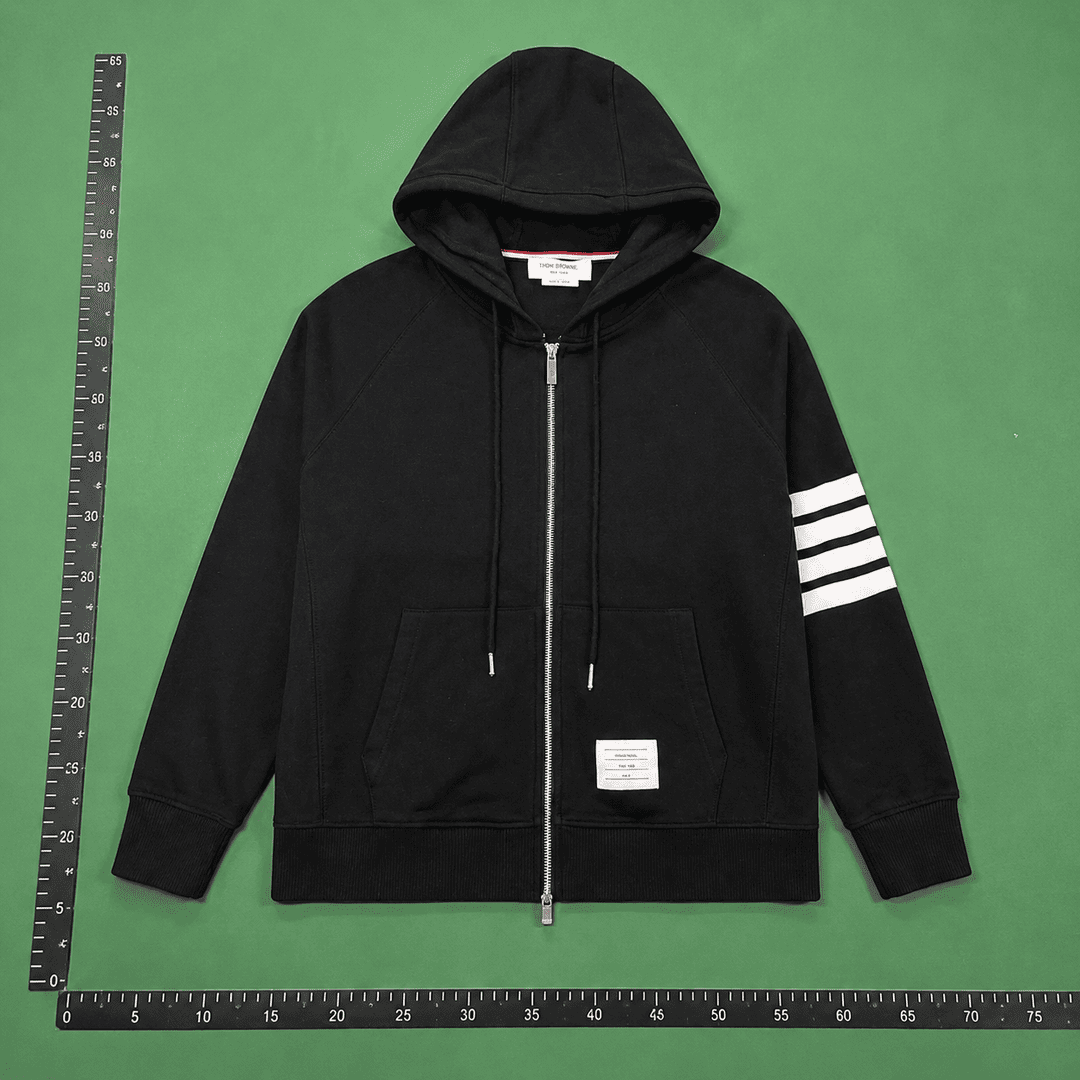
This QC review focuses on the specific product on fashion-reps: "Thom Browne Multicolor Hoodie and Pullover Collection in Yarn-Dyed Cotton, S–XXL." It combines multiple colors and hooded and non-hooded styles on the same product page, with the catalog listing it as 100% cotton, yarn-dyed, relaxed fit, and sizes S–XXL. The page also shows that the QC photos for this product were updated on September 26, 2026.
First, it's important to clarify: QC photos only help buyers verify the style, color, logos, stitching, and obvious flaws visible in the pictures; they cannot independently prove authenticity, actual feel, or final quality. The product catalog also has an inconsistency where the title says "hoodie collection" but the description mentions a collarless pullover, so you must confirm the specific color code and style before placing an order. 🔍
Clarify the Thom Browne Knit QC Verification Goals
The goal of this review is not to determine whether the item is "authentic," but to complete four actionable steps:
- Confirm whether the color code you selected corresponds to a hooded or non-hooded style.
- Examine the collar, cuffs, and overall knit texture separately, looking for obvious asymmetry, looseness, or surface irregularities.
- Check the size tag, brand logos, and stitching positions against the selected style.
- If the QC photos cannot cover key areas, request clarification from the seller or explore possible return/exchange options before deciding to ship.
This method is suitable for buyers who rely on QC photos to confirm style and visible craftsmanship. It is not for those who use photos as a basis for material feel, wearing comfort, durability, or authenticity guarantees.
Enter the Product Detail Page and Confirm the Current Style
First, open the product detail page and confirm that the page title is "Thom Browne Multicolor Hoodie and Pullover Collection in Yarn-Dyed Cotton, S–XXL." Do not infer the QC status of the current product from images on the homepage, brand pages, category pages, or other products.
After entering the detail page, focus on checking the following catalog information:
- Material: The page states 100% cotton.
- Dyeing: The page states yarn-dyed, but this cannot be used to infer that every color in the photos has no deviation.
- Fit: The page states relaxed fit.
- Sizes: The page lists S–XXL but does not provide complete garment measurements.
- Style: The color codes include both hooded and non-hooded descriptions.
- Weight information: The page mentions 180–250 grams and associates it with summer wear; this is not sufficient to prove the product is suitable for all fall/winter scenarios.
The color codes shown on the page include 4 navy, 24 hooded, and 25 hooded. The codes mix a navy non-hooded option with hooded options, so you cannot place an order based solely on the product title or thumbnail. 🧵
Open the Corresponding QC Gallery via View QC Photos
After confirming the current product details are correct, click the button labeled "View QC Photos" on that product page to enter the corresponding QC gallery for this item. Do not manually guess the QC URL, and do not substitute images from similar products, the same brand's pages, or search results for the current product gallery.
After opening the gallery, first confirm that the images indeed correspond to the current product, then review them in the following order:
- Start with an overall image to confirm the hood, collar, sleeve length, main color, and stripe layout.
- Then look at edges like the collar and cuffs to check for obvious deformation or loose threads.
- Examine front and side details to confirm that stripes, seams, and stitching are continuous.
- Finally, zoom in on the size tag, brand logos, and any other decorative elements.
The specified QC image is shown below, corresponding to the QC photo record for the above product:

What can be seen in the image depends on the original photo's angle, clarity, and coverage. Areas not captured in a single photo should be marked as "not verified" rather than assumed to be problem-free. 📷
Check the Collar, Cuffs, and Overall Knit Texture
First, look at the collar. For hooded styles, confirm that the hood opening and its connection to the body are intact, and whether hood strings or related parts are present in the current variant; for non-hooded styles, check that the collar or lapel structure matches the seller's selected style. If the catalog text and photos show inconsistent collar types, pause judgment and confirm with the seller.
Next, look at the cuffs. It is recommended to compare the left and right cuffs separately, not just one side. Pay attention to:
- Whether the ribbing width is noticeably different.
- Whether one side is loose and the other tight.
- Whether there are visible loose threads, skipped stitches, or fraying on the edges.
- Whether the cuff color is consistent with the body and stripe design.
The overall knit texture should be assessed from both close-up and distant angles. The visible texture density, color distribution, and surface undulations in the photos can be recorded, but cannot be used to assert actual thickness, softness, or warmth. Although the page states 100% cotton and a weight range of 180–250 grams, these should still be treated as catalog information, not physical measurements proven by the photos.
The product page specifically notes that the 4-Bar stripe is a key area to focus on for this style family. When checking, observe the stripe width, spacing, edge clarity, and whether the stripes align continuously across side seams. If the photos show stripes that are noticeably raised, reflective, or appear to be overlaid on the knit surface, this can only be recorded as a visible phenomenon in the photo, not directly used to draw conclusions about authenticity.
Separately Check the Size Tag, Brand Logos, and Stitching
The size tag and brand logos should be checked separately, not mixed in with the garment's overall appearance.
| Verification Area | Evidence that can be recorded from photos | Conclusions that cannot be drawn directly |
|---|---|---|
| Size tag | Whether the specific marking from S–XXL is legible, and whether the position matches the garment structure | Cannot infer actual chest circumference or wearing ease from the size tag alone |
| Brand logos | Whether the lettering, position, color, and edges are clear and visible | Cannot prove authenticity from logo photos alone |
| Stripes and seams | Whether stripe width, spacing, and side seam alignment are observable | Cannot judge the entire garment from a single limited-angle photo |
| Stitching | Whether there are obvious skipped stitches, loose threads, crookedness, or asymmetry | One loose thread alone cannot determine if the product is qualified |
The page does not provide complete garment measurements, so do not treat the size tag as body measurements. A safer approach is to ask the seller for measurements in centimeters of garment length, chest, shoulder width, and sleeve length, and compare them with your own clothing or body measurements. The page also mentions that sizing recommendations for authentic 4-Bar hoodies are inconsistent, with some sources suggesting one size up and others suggesting two sizes up; therefore, you cannot apply a single "fixed sizing-up rule." 📏
If the photos show hardware, hood string ends, or other decorative elements, they should be checked separately for attachment, symmetry, and surface condition. However, the current product information does not list the complete hardware configuration for each color code, so unphotographed parts cannot be assumed.
Distinguish Visible Evidence from Editorial Judgment
You can divide the QC record into three layers:
The first layer is visible evidence, such as "a loose thread appears on the edge of the left cuff," "the size tag cannot be read clearly in the current image," or "whether the 4-Bar stripes align continuously at the side seam still requires a larger image." These descriptions should correspond to specific locations and photo areas as much as possible.
The second layer is limited judgment, such as "current images are insufficient to confirm this area," "the color code is inconsistent with the style description on the page," or "need the seller to provide measurements." These judgments help the buyer decide on the next step, but still do not equal a quality conclusion.
The third layer includes content that cannot be derived from QC photos, such as authenticity, actual feel, smell, wearing comfort, long-term durability, and the complete condition upon receipt. The page also mentions that authentic items may occasionally have loose threads, so finding a single loose thread does not complete an authenticity check.
It is recommended to keep the following information in your order records: product name, selected color code, selected size, QC photo date, verified areas, unverified areas, and questions asked to the seller. This helps avoid mistaking photos of another color or another item for evidence of your current order. 📝
Stop Conditions When Information is Insufficient or Suspicious
Do not confirm shipping directly if any of the following occur:
- The QC photos do not clearly show the color code you actually selected.
- The page describes a hooded style, but the photos show a non-hooded collar style, or vice versa.
- The size tag, brand logos, or key stitching areas are illegible.
- Stripes are obscured at critical seams, making it impossible to judge continuity.
- There are obvious holes, severe loose threads, significant asymmetry, or suspected stains on the collar, cuffs, or body.
- The seller cannot provide the centimeter measurements you need, and the page has no garment dimensions.
- The photos contradict the product title, catalog fields, or selected color code.
At this point, you should ask the seller specific questions, such as "Please confirm whether color code 4 is the non-hooded navy style," "Please provide additional photos of the size tag and side seam stripes," or "Please provide chest and garment length measurements in centimeters." The more specific the question, the easier it is to get a documented answer.
Minor loose threads alone do not automatically equate to serious defects; but if loose threads are accompanied by seam opening, structural deformation, or widespread loose stitching, you should ask the seller to explain whether it can be handled. Do not skip key evidence checks just to rush shipping. ⚠️
Return/Exchange or Clarification Steps After Completing QC Review
After completing the review, you can proceed based on three outcomes:
- Sufficient evidence and consistent with the order: Save the QC photos and selection records, then decide whether to proceed based on the current service fees and international shipping costs displayed by the shopping agent platform.
- Insufficient evidence but no obvious defects: First request additional photos, measurements, or style confirmation, and re-check after receiving a response.
- Obvious issues or structural flaws: Within the platform's allowed window, consult about returns, exchanges, refusal of delivery, or other after-sales options, and keep the product page, QC photos, and communication records.
Currently, there are no buyer reviews or QC discussion records for this specific listing, so you cannot supplement photo evidence with buyer wearing feedback. The price, service fees, and international shipping costs on the page also need to be re-confirmed when ordering through the shopping agent platform; do not treat the reference price on the product page as the final payment amount.
The final judgment should revolve around one question: Have you confirmed the specific style, color, size, and visible condition of key areas? If the answer is no, pausing shipping and continuing to seek clarification is usually safer than dealing with issues afterward.