Check Nike Hoodie QC Pics: Color, Size, Print Before Order
- Topic
- general
# Check Nike Hoodie QC Pics: Color, Size, Print Before Order ## The Nike Hoodie QC Verification Task This Article Solves If you're planning to buy this Nike black oversized [hoodie](https://fashion-reps.net/hoodies), the real issue isn't whether the pictures look good—it's whether the QC photos are enough to confirm your chosen color, size, print, and overall condition. After reading this article, you should be able to do three things: confirm that the photos actually correspond to the target it
The Nike Hoodie QC Verification Task This Article Solves
If you're planning to buy this Nike black oversized hoodie, the real issue isn't whether the pictures look good—it's whether the QC photos are enough to confirm your chosen color, size, print, and overall condition.
After reading this article, you should be able to do three things: confirm that the photos actually correspond to the target item; record the facts that are directly visible in the photos; and request additional shots or pause your order when evidence is insufficient. This article does not apply if you only have the product's main image with no corresponding QC photos, or if you need to determine authenticity, fabric composition ratios, or long-term durability. QC photos can only help verify the visible condition; they cannot provide authenticity or quality guarantees.

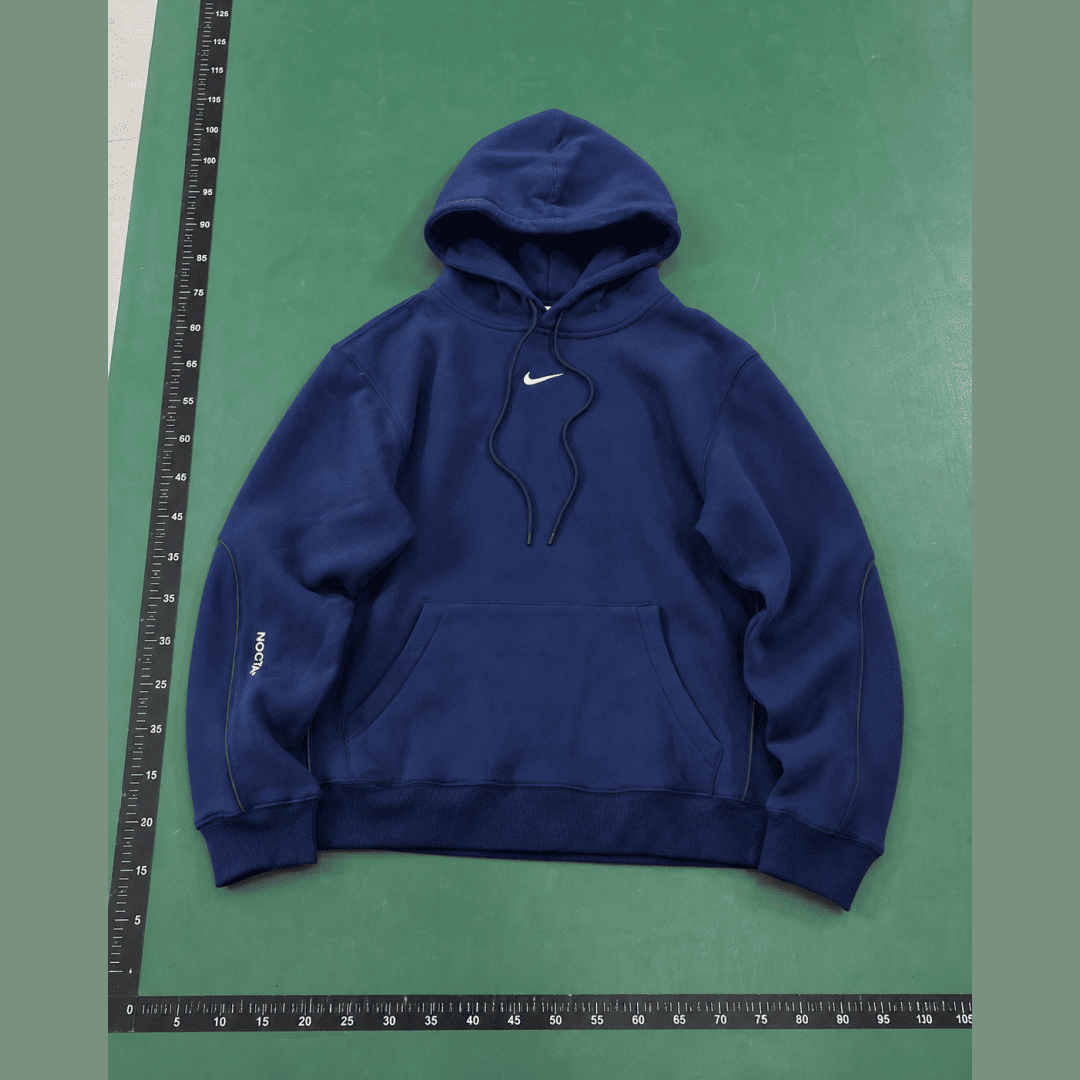
Image: The subject of this article's verification is the QC photos for the Nike black oversized street-style hoodie. The photos are used to check the visible appearance, not to represent the wearing effect or quality certification.
Enter the Target Site's Product Page and Confirm Specifications
First, confirm the product name on the fashion-reps product detail page, then check the basic information on the page. The current product is described as having a cotton main fabric, fleece lining, oversized fit, long sleeves with a hood, and lists sizes S–XL. The page also lists a weight range of 351–400 g, five colors, and decorations such as rubber or screen printing.
This information is the catalog description on the product page, not the facts that the QC photos have proven. Before ordering, you should re-verify the color and size you intend to purchase against the seller's page, especially noting the 2 cm size tolerance mentioned on the page. If you need precise chest, length, or sleeve measurements, you should refer to the seller's size chart or request additional measurement photos.
The reference price was shown as $41.94, but the final product cost, service fees, and international shipping need to be reconfirmed on the shopping agent page. Price is not something that QC photos can prove, and you should not skip photo verification because of price changes.
Obtain the Corresponding Product Photos via View QC Photos
After entering the product detail page, use the entry labeled View QC Photos to confirm that you are opening the QC photo gallery for this specific product. Do not guess the QC address, and do not substitute photos from the homepage, brand page, category page, or other products.
After entering the photo gallery, first check the following correspondences:
- Is the product name still this Nike black oversized hoodie?
- Do the fit, pockets, hood, and prints in the photos match the product description?
- Do the photos cover the color you intend to buy, not another colorway?
- Can you see the full body, neckline, cuffs, hem, and main print areas?
- Are the photos clear enough to judge the color, size label, and surface condition?
If the photos only show partial views, have severe glare, excessive compression, or cannot be confirmed to match the product, they cannot be considered complete QC evidence. 🧭
Visible Evidence for Color, Size, and Print Placement
Color Check
First, match the color in the QC photos with the selection on the product page. The black body may appear in different shades under warm light, cool light, and shadows, so focus on whether the body, hood, sleeves, and pockets are consistent in color, and check for any obvious color differences in decorative stitching or edges that are not described on the page.
Do not judge whether the actual color is exactly the same based solely on the black on your screen. If the photo is overexposed, has significant background reflection, or uses colored lighting, you should write the conclusion as "the current photos cannot fully confirm" rather than directly judging the color as correct.
Size Check
First, look for identifiable size information on the size tag, packaging label, or QC record, then compare it with your order selection. The tag can only help confirm the labeled size; it cannot prove the actual chest and length measurements of the garment.
The product page lists sizes S–XL and notes a 2 cm measurement error. If you are concerned about the oversized fit, you should compare the seller's flat measurements with a hoodie you already own, rather than ordering based solely on your usual size. 📏
If the size tag is not visible in the photos, or the text is blurry, you should request additional photos of the tag and complete flat measurements. When the size cannot be confirmed, pausing the order is usually safer than dealing with returns or exchanges after receiving it.
Print Placement and Edges
Check the following visible items around the chest, sleeves, or other print areas clearly shown on the page:
- Is the graphic located in the same area as shown on the page?
- Are there obvious skews, missing letters, or misalignments in the text or graphics?
- Are there obvious glue overflow, cracks, rough edges, or large wrinkles on the print edges?
- Are there obvious inconsistencies in left-right graphics, repeating elements, or symmetry lines?
- Do visual changes caused by shooting angle, folding, and lighting significantly affect judgment?
QC photos can only show the appearance at the time of shooting; they cannot prove that the print will not crack or peel after long-term washing. If the print is obscured by folds, it is more meaningful to request close-up photos in a flat state. 🔍
Itemized Record of Stitching, Labels, and Surface Flaws
QC inspection should go from overall to detail, not just focus on brand logos. It is recommended to save records in the following order:
- Overall: Is the garment intact, with no obvious stains, holes, severe creases, or asymmetry?
- Neckline and hood: Are there obvious loose threads at the seams? Are the drawstrings and metal parts complete and visible?
- Cuffs and hem: Is the ribbing obviously loose, damaged, or different left and right?
- Pockets: Do the position, shape, and stitching match the product page description?
- Print: Are there clearly visible issues with position, edges, or surface?
- Labels: Can size tags, care labels, or other labels be read, and do they match the order specifications?
- Surface: Are there obvious loose threads, color differences, stains, snags, or shipping damage?
Do not directly write off ordinary creases as flaws, and do not write "no problems" for areas that are unclear in the photos. A more accurate record is "no obvious issues found in the photos" or "this area lacks sufficient clarity to confirm."
| Check Item | What Can Be Confirmed from QC Photos | What Still Needs Supplement or Cannot Be Confirmed |
|---|---|---|
| Color | Main body color and obvious color differences | Exact match between screen display and actual item |
| Size | Recognizable tag or order marking | Actual chest, length, and wearing ease |
| Placement, missing parts, obvious skew, or surface anomalies | Durability after long-term washing | |
| Stitching and flaws | Loose threads, damage, and stains in clear areas | Condition of obscured, reflective, or low-resolution areas |
| Labels | Readable tag information in photos | Authenticity, brand authorization, and proof of origin |
Separating Visible Facts from Editorial Judgment
Editorial judgment must be based on visible evidence. For example, seeing a size tag with "L" in the photo is a visible fact; "size L will definitely fit you" is a judgment that cannot be directly drawn. Seeing the print on the chest is a visible fact; "the print quality is good" requires clearer close-ups and more cautious wording.
It is recommended to divide QC records into two columns:
- Visible facts: colors, labels, positions, loose threads, stains, or damage that can actually be identified in the photos.
- Next-step judgment: whether additional photos are needed, whether to contact the seller, whether to proceed with the order.
The current product page does not have independent buyer feedback, so you cannot infer shrinkage, warmth, wearing comfort, or long-term durability from this set of QC photos. The product page mentions fleece lining and a weight range of 351–400 g, but this is still catalog information, not a temperature rating. 🧾
How to Request Additional Photos or Pause When Images Are Insufficient
When photos cannot support key decisions, you can make specific requests to the shopping agent rather than vaguely saying "please check quality." Suggested requests:
- Full front flat lay of the garment to confirm color, fit, and print placement.
- Close-up of the size tag to ensure the text is legible.
- Front close-up of the chest and other main prints, avoiding glare and folds.
- Detail shots of the neckline, cuffs, hem, and pocket stitching.
- Clear close-ups of areas with suspected stains, damage, or obvious loose threads.
- If size selection depends on measurements, provide photos or records of flat chest, length, and sleeve measurements.
If you still cannot confirm color, size, or print condition after additional photos, do not rush to order. Pause the process and keep the product page, order specifications, and QC records until the evidence is complete. ⏸️
Pre-Order Checklist for Links, Specifications, and QC Records
Before ordering, confirm item by item:
- You have entered View QC Photos from the target product detail page, not using a guessed photo URL.
- The QC photos correspond to the Nike black oversized hoodie, not related products or other colorways.
- The order color matches the color verified in the photos.
- The order size matches the recognizable tag; if no tag, you have requested additional photos.
- You have checked the body, hood, pockets, cuffs, hem, prints, and main labels.
- You have recorded what the photos can prove, without writing invisible content as conclusions.
- For blurry, reflective, obscured, or low-resolution areas, you have made specific requests for additional shots.
- You have distinguished between the product page catalog information and QC photo evidence.
- When key items remain unconfirmable, you choose to pause rather than leave the risk until after receipt.
The final decision should depend on whether the evidence is sufficient, not on the number of photos. A set of QC photos that clearly covers key areas is more useful than many photos that cannot be matched to the product or show unclear details.