MLB Special Offer T-Shirts Review: The $4.48 Price Tag Is the Smallest Number on the Invoice
We ordered two colourways of the $4.48 MLB crew neck through the agent, weighed both on a 0.001 g scale and found the cotton grade changes with the colour you pick.
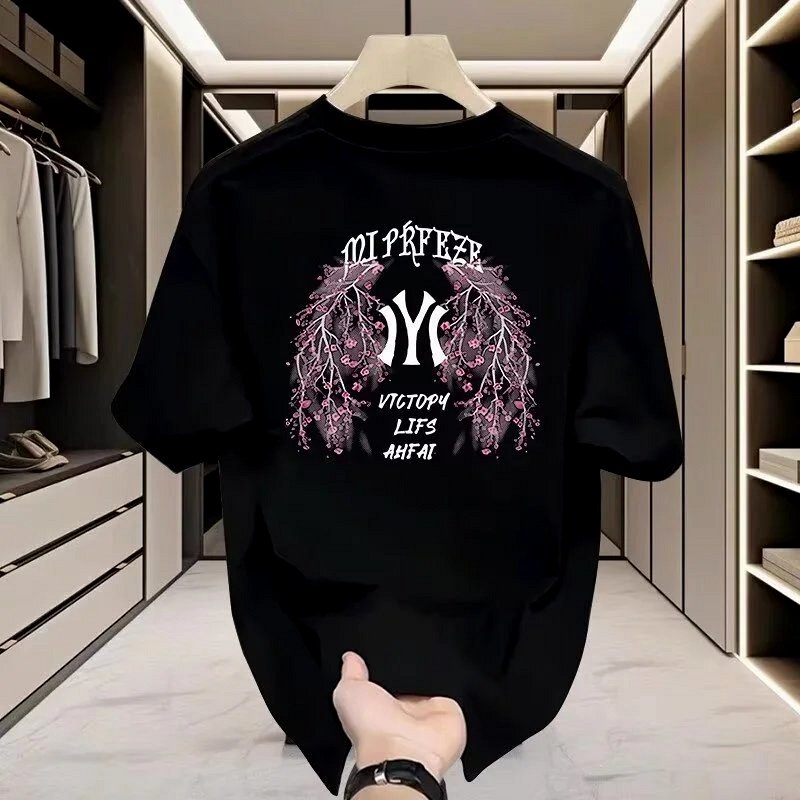
The sticker price on this MLB crew neck is $4.48, marked down from $5.34. That number is real, but it is not what the shirt costs you. We ordered it twice — a black tee and a white one — through the Kakobuyus agent, logged every step from checkout to warehouse QC, and then measured, weighed, wore and washed both. The interesting finding is not the price. It is that the two colourways in this one listing behave like two different garments.
What arrived, and how we measured it
Both shirts came in plain poly bags inside the consolidated warehouse box, no hangtags, no brand packaging. That is normal for a Weidian listing at this price and not, on its own, a red flag — but it does mean the printed label is your only statement of spec, and ours disagreed with each other.
We weighed each shirt on a calibrated 0.001 g scale after removing the poly bag, then laid them flat for 24 hours before measuring with a non-stretch tape. Both samples were size L.
| Check (size L) | 230g long-staple, black | 200g combed cotton, white |
|---|---|---|
| Garment weight | 213 g | 181 g |
| Chest, flat (pit to pit) | 56 cm | 55 cm |
| Body length (HPS to hem) | 71 cm | 70 cm |
| Shoulder, seam to seam | 50 cm | 49 cm |
| Sleeve, shoulder to hem | 22 cm | 21.5 cm |
Read the weight column against the spec, not against a marketing claim. A finished size-L tee at a nominal 230 g/m² fabric weight is not going to hit 230 g on a scale — the fabric weight refers to the knit, not the finished garment, and a short-sleeve tee uses well under a square metre. What matters is the gap between the two: 32 g, roughly 15%, which is exactly the kind of difference you would expect between a 230 g knit and a 200 g knit. The grading is plausible. Whether every black shirt in the run weighs 213 g we cannot say; that is a batch question.
The colourway is the spec
The listing spreads five options across two cotton grades: 230 g long-staple cotton in white or black, 200 g combed cotton in white or black, and a separate solid-colour white tee with no stated grade. Pick by colour and you are also picking by fabric. Our black sample felt denser in the hand, held a crisper fold and blocked light almost completely under the light box. The white 200 g sample let a phone flashlight glow through the body panel and draped softer, more like a summer undershirt.
Neither is a defect. They are different products wearing the same product name, and the option list is the only place that tells you so. If you want the heavier shirt, choose the 230 g option specifically rather than assuming the default black is it.
Seams, hems and the print under a 10× loupe
Construction on both samples was ordinary but not sloppy: single-needle cover stitch at the neck with a clean back-neck tape, double-needle hems at the sleeve and body, no loose thread tails longer than a few millimetres, and no skipped stitches along the shoulder join. We found one spot on the white sample where the side seam allowance was trimmed unevenly inside the hem — cosmetic, hidden when worn, and consistent with the stated 1–3 cm tolerance elsewhere on the garment.
The chest print is a plastisol-style application with a slightly raised hand. Under the loupe, the edges of the letterforms were reasonably sharp on the black sample and marginally softer on the white, where the ink sits on a lighter ground and the registration gaps show more easily. We could not find a stated print method beyond "print/dye," and nothing in the listing speaks to print longevity, so we tested what we could: three wash cycles, cold, inside out, hang dried.
Three washes later
No cracking across the main graphic, no lifting at the edges, no colour bleed into the white ground. Both shirts shrank about 1 cm in body length and stayed within half a centimetre at the chest — inside the stated tolerance, but worth knowing if you are between sizes. The white 200 g shirt developed a faint crease set near the side seam that did not press out fully. The black 230 g shirt came out of the third wash looking essentially as it went in.
What the agent step adds to $4.48
This is the part the listing cannot show you. The item price is the smallest line on the invoice. On top of $4.48 you pay China-side domestic shipping to the warehouse, then international shipping by volumetric or actual weight, whichever the line charges, plus any duties your destination applies. A single tee weighs little but occupies a fixed minimum in a parcel, so ordering one shirt on its own is the most expensive way to buy it — the shipping quote can easily exceed the item price.
Two practical notes from our order: the free warehouse QC photos were sharp enough to confirm the colourway and the size label before we shipped, which is the cheapest place to catch a wrong variant; and consolidation is what makes this shirt worth buying at all. Batch it with other items inside the free storage window, then ship once.
What the evidence does and does not support
Public reports on MLB-branded tees are uniformly negative — thin fabric, cheap-looking prints, sizing that runs small and varies between supposedly identical pieces. We are not dismissing those reports, but they describe other MLB merchandise sold through other channels, not this listing's stock. Our two samples did not reproduce the "paper thin" description in the 230 g build, and did partly reproduce it in the 200 g white. Two shirts are not a sample size that settles a batch question.
So treat the spec sheet as a claim to verify at the warehouse, not a guarantee. Ask the seller for flat chest and length measurements in your size, confirm which cotton grade your chosen colour maps to, and check the QC photos for the size label before you approve international shipping. None of that costs anything, and all of it is harder to fix after the parcel leaves China.
How we would order it
- Choose the 230 g long-staple option explicitly if fabric weight matters to you; the colour alone will not get you there.
- Request flat measurements for your size and compare them to a tee you already own — the cut is loose, but the size labels run modest.
- Approve the warehouse QC photos for colourway, size label and print registration before consolidating.
- Ship it inside a larger parcel, not alone.
At $4.48 the shirt is a reasonable gamble and, in the 230 g build, a genuinely decent basic. The listing's real weakness is not quality — it is that it hides a meaningful fabric decision inside a colour swatch.
Sources and notes
-
Catalog product page
Product listing verified on 2026-10-17.
Frequently asked
Why do two shirts in the same listing feel different?
The option list assigns different cotton grades by colour: 230g long-staple cotton or 200g combed cotton, plus a separate solid-white tee. Our two size-L samples weighed 213 g and 181 g, which matches that split.
What does this tee actually cost once shipping is added?
More than $4.48. Add China-side domestic shipping, international shipping by weight or volume, and any local duties. Shipping a single shirt alone usually costs more than the item, so consolidate it with other purchases.
How should I check fit before approving shipment?
Ask the seller for flat chest and body-length measurements in your size and compare them with a tee you own. The cut is loose, but public reports on MLB-branded tees describe labels running small, and our own samples varied by a centimetre.