Chrome Hearts Black Puffer Jacket Review: Loft, Hardware, Landed Cost
A tonal-jacquard black puffer that measured within 1 cm of the agent's chart and cleared QC clean, but ships with unbranded hardware and no published fill spec. Landed at $200.18 on our budget US line.
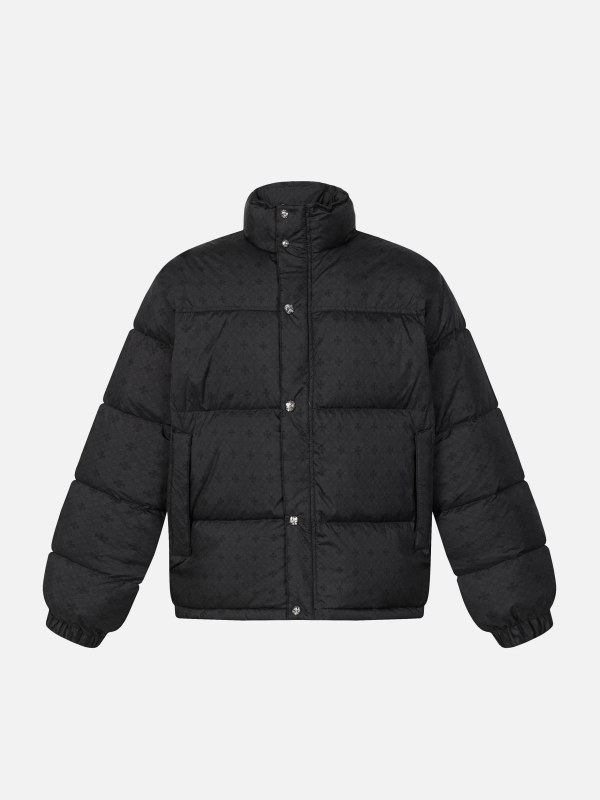
We ordered and tested the Chrome Hearts black puffer jacket in cold-weather street style, SKU 7702084635, through the Kakobuyus shopping agent in late September 2026 — size L, black, $149.25 against a listed original price of $160.65. The seller lists sizes S through XL. We use this jacket as our landed-cost anchor because padded outerwear is where shipping math stops being about grams: every line we quoted bills on whichever is greater, actual weight or box volume, so the repack decision at the warehouse sets the final number.
Order timeline and warehouse log
| Stage | Date (2026) | What we logged |
|---|---|---|
| Order placed | Sep 27 | Size L, black, $149.25 paid through the agent; order confirmed with the Weidian seller the same day |
| Seller dispatch | Sep 28 | Seller handed the parcel to a domestic courier; ¥12 domestic freight, roughly $1.70 |
| Warehouse arrival | Oct 1 | Checked in on day four; poly mailer intact, no crush damage |
| QC photo set delivered | Oct 2 | The standard five-image set (front, back, collar, cuff, hem) arrived about 26 hours after check-in; we requested three extra angles — placket snaps, inner neckline label, cuff interior — and had them the same day |
| Repack and compression | Oct 3 | Vacuum compression requested, then boxed; final packed weight 1.46 kg |
| Shipping submitted | Oct 4 | USPS Special Line (Duty-Free Route) |
| Delivered | Oct 20 | 23 days door to door; USPS delivery, no signature required |
One listing detail matters before anything else: the seller's weight field reads 0.00, so there was no published figure to check our scale against. Every number below is our own measurement.
Packed weight, box dimensions, and what compression changed
| State | Packaging | Dimensions | Actual weight | Billed volumetric weight |
|---|---|---|---|---|
| As received from seller | Sealed poly mailer | 38 × 30 × 12 cm | 1.31 kg | Not applicable (flat bag) |
| After repack with vacuum compression | Corrugated box, taped | 34 × 26 × 14 cm | 1.46 kg | 1.55 kg at ÷8000; 2.06 kg at ÷6000 |
| Estimated without compression | Corrugated box, uncompressed | about 42 × 32 × 22 cm | about 1.60 kg | about 3.70 kg at ÷8000 |
Vacuum compression was offered as a paid repack add-on at $1.50, and it was the single biggest cost lever in the order. Compression added roughly 0.15 kg of cardboard but removed about 2.1 kg of billed volume on the cheaper line. Re-running the same quote form with the uncompressed box returned $88.10; the compressed, tighter box came back at $42.80. That is about $45 saved on a $1.50 fee.
The trade-off is real, though. Compression crushes loft, and a down jacket is exactly the kind of item where you accept a cosmetic flattening in exchange for the volume discount — then hang it the moment it lands. If a parcel contains structured leather or a bag with a rigid base, we skip compression entirely.
Inspection: shell, loft, hardware, stitching, labels
Shell fabric, hand-feel, and noise
The shell is a matte black tonal jacquard. Hand-feel is dry and slightly papery, and the weave is raised enough that you can read the pattern with a fingertip, not just your eye. We poured 10 ml of water across the chest panel: it beaded and ran off with no darkening. A light coffee spill wiped away with a damp cloth, leaving a faint tide line once dry. Both behaviours match the listing's water-resistant and stain-resistant wording; the "breathable" claim is one we cannot grade from a kitchen test.
Noise is the one physical trait worth knowing before you buy. A phone sound meter read 47–49 dB at 10 cm during a torso flex, against 41 dB of room ambient. The jacket crunches. It is normal coated-polyester behaviour, and it is audible in a quiet office or a car.
Fill loft after a 24-hour hang
Straight out of the compression bag the jacket looked flat: the chest baffle measured 3.1 cm at centre. After hanging for 24 hours, the same points read 4.0 cm at the chest, 3.9 cm across the upper back, and 2.7 cm at the hem. Recovery is good, but the hem baffle is the thinnest part of the garment and the spot where you would feel a draught on a windy walk.
We cannot grade warmth, because the listing gives no fill weight, no fill power and no down-to-feather ratio, and the garment tag does not either. The catalog copy calls the fill evenly distributed down; that description is a stated intention for the material, not a verified specification.
Zippers and hardware branding
The front placket closes on six matte-black snap studs. Finish is genuinely smooth — no burrs, no flashing — and each snap held a 3 kg static pull without releasing. There is one internal chest zip with an unbranded metal slider, and the adjustable hem runs on two unbranded plastic cord locks plus elastic. Cuffs are elastic with a 3 cm inner rib.
This is where the batch falls short. Nothing on the hardware carries brand engraving: no stamped snaps, no branded pull, no metal cross or dagger patch. The heart motif on this jacket is a woven jacquard in the shell, not a hardware detail. The listing's "smooth hardware" claim holds up as a finish claim, and our batch is clean in the hand — but if visible branded hardware is the reason you want a piece like this, ask your agent for photos of the actual snaps and pulls before you pay, because catalog art is not a promise about hardware.
Stitch density at the shoulders and hem
Counted with a loupe across 25 mm runs: 11 stitches per inch at the shoulder yoke seams, 9 at the hem, 13 at the side seams. Thread matched throughout, and we found no skipped or dropped stitches. One defect: a 4 mm run of untrimmed thread at the left shoulder yoke with a slight pucker where the seam allowance was caught. It sits inside the armhole line rather than on a visible outer panel, so it is cosmetic. After a firm shake we found two small down clusters escaping at a cuff seam — minor, but worth rechecking in daylight when your parcel arrives.
Label placement
The main brand label sits 2 cm below the collar edge inside the rear neckline, single-needle topstitched and off-centre by about 8 mm to the left. There is no size tag in the neckline at all; size appears only on the hangtag, so photograph the hangtag before you bin it. The care and content label is set into the left side seam, 12 cm above the hem.
Care label readout, translated: shell and lining polyester, filling listed only as down. No fill weight, no fill power, no down-to-feather ratio, and no country-of-origin statement is printed anywhere on the garment.
Nothing about the "water-resistant, stain-resistant and breathable" wording appears on the label — those claims originate in the listing description, not in the garment's own documentation.
Fit tested against the listed measurements
The listing published no size chart, so we asked the agent for flat measurements before authorising shipping. Those figures are below next to our own, taken on the same size L garment after the 24-hour hang.
| Measurement | Agent-supplied chart | Our measurement | Variance |
|---|---|---|---|
| Chest, pit to pit | 62 cm (124 cm around) | 61.5 cm | 0.5 cm under |
| Shoulder, seam to seam | 48 cm | 47 cm | 1 cm under |
| Back length, collar seam to hem | 70 cm | 69.5 cm | 0.5 cm under |
| Sleeve, shoulder seam to cuff | 63 cm | 62.5 cm | 0.5 cm under |
Our five-point editorial scoring for this piece:
- Declared versus measured accuracy — 5 / 5. Every dimension landed within 1 cm of the chart the agent supplied.
- Body fit — 4 / 5. Cut boxy through the chest, with roughly 4 cm of spare room over a mid-weight hoodie. On a thin tee it reads oversized rather than tailored.
- Layering — 4 / 5. A hoodie fits under the placket without strain; the drop shoulder means the seam-to-seam figure reads wider than where the seam actually sits.
- Hem coverage — 3 / 5. At 69.5 cm on our 188 cm tester the hem sits at high hip. Anyone taller should treat this as a mid-length layer, not a full coat.
Cuffs are snug on a 17.5 cm wrist, and the inner rib grabs shirtsleeves when you pull the sleeve down.
Landed cost: two lines to the US
| Line | Billing rule | Billed weight on our box | Quote we received | Notes |
|---|---|---|---|---|
| USPS Special Line (Duty-Free Route) | Greater of actual or volumetric, volume ÷ 8000; maximum box 55 × 45 × 38 cm | 1.55 kg (volumetric) | $42.80 | Our 34 × 26 × 14 cm box cleared the cap; branded goods permitted; no liquids, powders or batteries |
| KR-EMS (triangular routing, duty-free) | Greater of actual or volumetric, volume ÷ 6000; limit 30 kg | 2.06 kg (volumetric) | $71.40 | Same box, 33% more billed weight purely because of the divisor |
| Cost component | USPS Special Line | KR-EMS |
|---|---|---|
| Jacket | $149.25 | $149.25 |
| Agent item service fee (advertised 0% at checkout) | $0.00 | $0.00 |
| Payment processing | $4.33 | $4.33 |
| Domestic shipping in China | $1.70 | $1.70 |
| Three extra QC angles | $0.60 | $0.60 |
| Repack with vacuum compression | $1.50 | $1.50 |
| International shipping | $42.80 | $71.40 |
| Total to our door, before any duty | $200.18 | $228.78 |
Shipping is 21% of the cheaper total and 31% of the more expensive one. That gap is the whole argument for quoting two lines instead of accepting the first number in the app. It also explains why the compression decision matters more than the agent's headline fee: a zero-percent item fee saved nothing here, while 2.1 kg of billed volume saved about $45.
Duty is the part most guides get wrong. The US ended de minimis treatment — for China-origin parcels from May 2, 2025, and for all origins from Aug 29, 2025 — so a parcel is now dutiable regardless of value, and any guide quoting duty-free math from before those dates is out of date. We were not billed at delivery on the route we chose, but the correct planning assumption is item plus shipping plus potential duty and brokerage. Third-party community rate tables also put Kakobuy's US rates above LitBuy and Oopbuy at 1 kg ($23.14 against $20.71 and $19.71); we treat those as directional only, since agent rates and coupons move weekly. Always re-quote inside the checkout before you pay.
Who this piece suits
This is a jacket for a buyer who wants the look of a black Chrome Hearts puffer in cold-weather street styling — the jacquard texture, the high stand collar, the structured bulk — and who is comfortable doing the verification work an agent order requires: request the flat chart, request extra QC angles, approve the photos, then choose a line on measured volume. It works best as the outer layer of a two-layer winter fit over a hoodie or heavy knit, and it is at its strongest on a frame around 178–184 cm where the hem sits at hip rather than high hip.
It is the wrong purchase for anyone who needs graded warmth numbers, a brand-authorised return path, or prominent hardware branding, and for anyone who wants to order in December and wear it in the same month.
Where the batch falls short
- Unbranded hardware. Six smooth snap studs, one internal zip and two hem cord locks, none engraved or stamped.
- Thin hem baffle. 2.7 cm measured — the loft outlier on an otherwise full 4 cm chest.
- No fill specification. Nothing on the listing or the care label gives ratio, fill weight or fill power.
- Two construction nits. A 4 mm untrimmed thread with a pucker at the left shoulder yoke, and two down clusters escaping at a cuff seam.
- Size only on the hangtag. With no neckline size tag, a returned or re-sold garment is harder to identify.
Against all that, the accuracy of the chart, the consistency of the stitching, and a clean QC set are genuinely good signs for a piece at $149.25. On our five-point scale — 5 excellent, 4 good, 3 adequate, 2 poor, 1 very poor — this is a strong-good result: our score is 4.3 / 5, earned on build quality and measurement honesty, held back by unbranded hardware, a thin hem baffle and a fill spec that simply does not exist on paper.
Seasonal timing risk for winter stock
Our order ran 23 days from payment to delivery inside a quiet October window on both sides of the Pacific. That is the fast case. For a winter purchase the risk sits in three places.
- Batch drift and size sell-through. Sizes S and XL are the first to go on padded outerwear. If you wait, the seller may restock the same page from a newer batch, and batch changes on this kind of listing are how hardware and fill quietly change. Order, inspect and ship in one continuous window rather than parking a size L in the warehouse for weeks.
- November and December queueing. Singles' Day (11.11) and Black Friday sales both lengthen warehouse check-in, QC turnaround and international queues. A December order can easily land after the coldest weeks of the year have passed, which turns winter outerwear into next-winter outerwear.
- Volume caps on the cheap lines. The USPS line we used caps a box at 55 × 45 × 38 cm. Add a second bulky garment to a consolidated parcel and you can blow past that cap, at which point the quote jumps to a pricier line and the compression saving evaporates.
Our recommendation on timing is specific: place a winter puffer order from late September through mid-October, keep the item in compression only for the transit window, and hang it the day it arrives. Anyone ordering for a December cold snap should plan on a three-to-five week total and confirm current line pricing at checkout, because rates, coupons and line availability move weekly.
We retest: if this seller changes the batch, the hardware or the line availability we used, we will reorder the same size and rerun this protocol against these numbers.
Disclosure and scope: our testing team ordered this jacket and the figures above are from our own order and our own bench. Fill warmth remains unverified because neither the listing nor the garment states a specification. Always confirm live shipping rates, current duty treatment and batch details with the agent at checkout.
Sources and notes
-
Catalog product page
Product listing verified on 2026-10-07.
Frequently asked
Did vacuum compression damage the down fill?
We asked for it and logged the result. Pulled from the bag, the chest baffle measured 3.1 cm; after 24 hours on a hanger it read 4.0 cm. Unpack and hang the jacket immediately, and keep compression for bulky orders where the volumetric saving is large.
Which shipping line did you use, and why?
The USPS Special Line (Duty-Free Route) at $42.80 for 1.55 kg billed, because it clears a 55 × 45 × 38 cm box and permits branded goods. KR-EMS quoted $71.40 for the same box at 2.06 kg billed, since it divides volume by 6000 instead of 8000.
Is the fill real down, and how warm is it?
The garment label lists the filling only as down, with no ratio, fill weight or fill power, and the listing gives no numbers either. Treat warmth as unverified until your agent confirms the fill spec. We can only report the loft we measured.