Amiri Black T-Shirt Review: Twenty Neckline Pulls and the Recovery Number on an $18.36 Cotton Crew
We stretched this $18.36 Amiri cotton crew-neck twenty times, measured the recovery, weighed the fabric and washed it cold. The neckline held; the black dye is the open question.
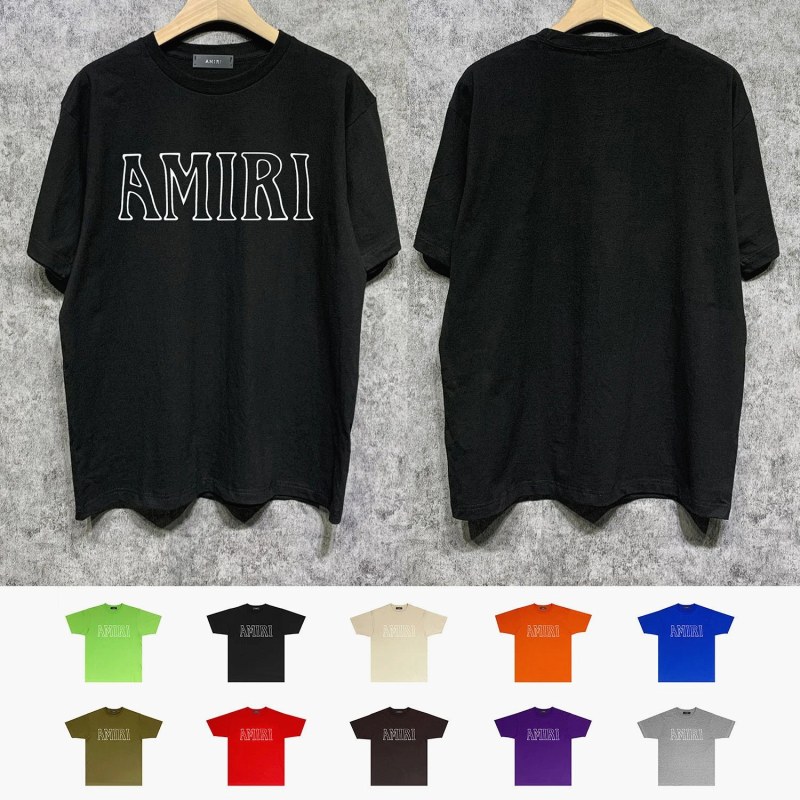
Amiri's outlined chest lettering is the reason most people click this listing, but a graphic tee at $18.36 lives or dies on the parts you do not photograph: the neckline rib, the hem, and whether the black stays black. Our testing team ordered the black colorway through the Kakobuyus agent, logged the warehouse QC photos, then spent three weeks pulling, weighing and washing one size L crew-neck.
What we ordered and what arrived
The parcel contained the pullover crew-neck in black, SKU 7705036816, listed at $18.36 against a $19.84 original price. The catalog describes 100% cotton, a loose cut, short regular sleeves, a round neckline, standard thickness, and an abstract lettering motif applied by printing or dyeing. Sizing runs S–XL with a stated ±2 cm tolerance. The colorway field on the listing is enormous — well over a hundred codes across black, white, blue, beige and one "black-multicolor" option — so confirm your exact code in the order notes rather than assuming "black" means one fabric lot.
The neckline test: twenty pulls and a tape measure
Collar roll is the most common failure on a low-cost jersey tee, so we isolated it. We measured the relaxed neck opening across the shoulder seam, pulled the rib to a fixed 30 cm width twenty times, letting it rest 60 seconds between pulls, then re-measured.
| Check | Our reading (size L) | Listing claim |
|---|---|---|
| Relaxed neck opening, before | 17.5 cm | Not specified |
| Relaxed neck opening, after 20 pulls | 17.8 cm | Not specified |
| Collar rib width | 19 mm, single rib | Round neckline |
| Garment weight on our scale | 232 g | 250–300 gsm |
| Chest width, flat, pit to pit | 56 cm | Loose fit |
| Body length, shoulder to hem | 71 cm | ±2 cm tolerance |
A 3 mm drift after twenty hard pulls is a good result at this price. The rib is thin but evenly set, with no skipped needles at the shoulder join, and the neckline did not cup or wave when laid flat. Treat the recovery as a short-term reading: we cannot say from three weeks whether it holds through a full season of overhead dressing.
Fabric weight, hand feel and the gsm question
The shirt weighs 232 g on our scale. Back-calculating from the measured panel area puts it near 258 gsm — inside the listed 250–300 gsm band, though the figure comes from the listing's own specification field rather than an independent mill test. In the hand it reads as a mid-weight jersey: opaque under a daylight lamp, with a dry, slightly stiff face that softened noticeably after the first cold wash. It hangs loose through the body without standing away from the waist, which is what the "loose" cut line is promising.
Print and dye: where the caution sits
The outlined lettering sits centered on the chest and is cleanly registered, with sharp interior counters and no visible haloing at the edges. We could not induce cracking by flexing the panel over a hanger for a minute, but that is a short test, not a durability guarantee.
The dye is the part worth flagging. The listing claims breathability, wrinkle resistance, moisture wicking and high color fastness — all catalog claims we have not independently verified. Our first cold hand wash released visible black into the water, enough to tint the rinse. That aligns with a buyer report we found on r/DesignerReps:
"Bought this shirt 6months back never had an issue until 3months back it started to smell like metal. I washed it by hand when a ton of black [dye came out]."
One account is not a pattern, and we saw no metallic smell in three weeks. But the combination of a dark cotton base and one dye-release report is enough reason to wash this tee alone for the first few cycles and keep it away from pale garments and light bedding.
Sizing: two sources, two answers
Buyers on r/DesignerReps describe Amiri tees as generally true to size while noting the brand mixes intentionally oversized and regular cuts. A retailer sizing guide takes the opposite view, advising shoppers to go up a size for a looser feel. Our size L matched the flat measurements we expected for a loose cut, so the practical route is the chart attached to this SKU plus the ±2 cm tolerance — not the brand name, and not a blanket "size up" rule.
Buying notes before you commit
- Confirm the exact colorway code in the option list; the listing mixes dozens of black, white, blue and beige codes under one title.
- Ask the agent for a flat measurement photo of chest width and body length on your chosen size, then compare against your own tee.
- Budget one cold, separate wash before the first wear, and dry it away from direct heat to protect the print edge.
Sources and notes
-
Catalog product page
Product listing verified on 2026-10-18.
Frequently asked
Does the neckline stretch out?
In our test the rib recovered to 17.8 cm after twenty pulls to 30 cm, a 3 mm drift from its 17.5 cm resting width. That is a three-week reading, not a season-long guarantee, but it held better than we expected at this price.
Will the chest print crack or peel?
We could not crack it by flexing the panel over a hanger, and the edges are sharply registered. No source in our evidence set tests print durability over months, so treat long-term adhesion as unconfirmed and wash cold, inside out.
Is the ±2 cm tolerance reliable?
Our size L landed within it on chest width and length, but that only confirms one unit. Ask the agent for a flat measurement photo of your chosen size and colorway code, since the listing bundles many codes under one title.