Bape White Hoodie in Relaxed Streetwear Style Review: A Flap-Pocket Spec, a Kangaroo Photo and a "Non-Iron" Claim We Stress-Tested
A $22.24 cotton loopback pullover whose spec grid names a flap patch pocket while its own description promises a kangaroo. We measured, weighed and wash-tested the white option.
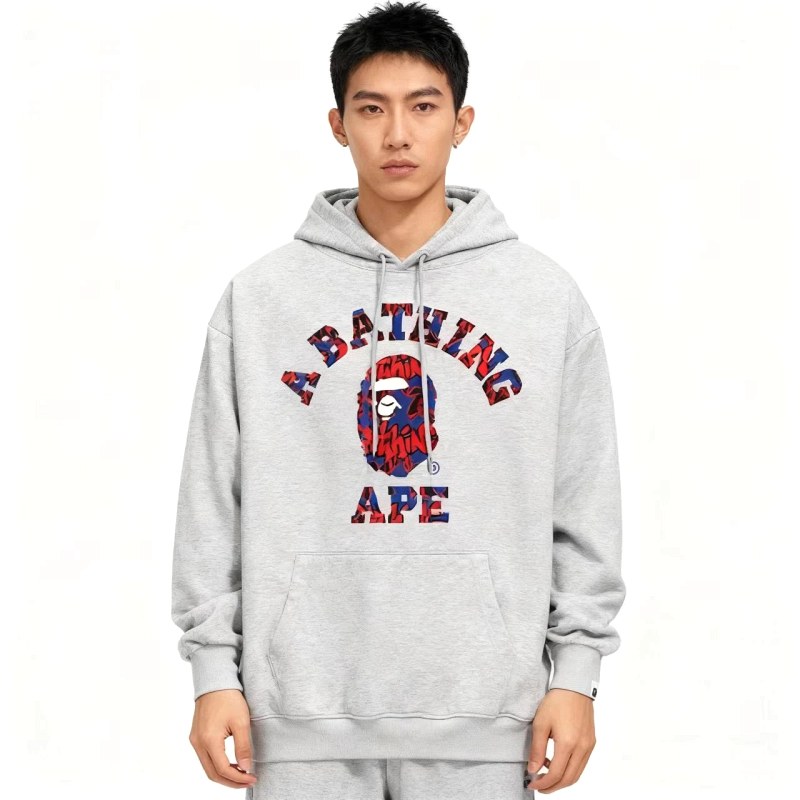
We ordered the Bape white hoodie in relaxed streetwear style through the Kakobuyus agent at $22.24, against a struck-through original of $23.51, under SKU 7705015242. It arrived as a single pullover in the white entry of the listing's long loopback color run — pullover hood, long sleeves, ribbed cuffs, chest graphic, front pocket. Our testing team's job on the bench was narrow and specific: the listing describes one pocket and its specification grid describes another, and it advertises a non-iron finish on a cotton loopback knit. Both claims are checkable with a tape measure, a light box and a wash cycle.
What arrived, measured on the bench
The parcel arrived without brand packaging. We logged the garment on the calibrated scale and with a measuring tape before anything else, working from the stated figures in the listing:
| Spec | Listing | Our sample (size L) |
|---|---|---|
| Main fabric / composition | Cotton / cotton | Cotton loopback terry, unlined |
| Weight band | 350–400 g | 407 g on the calibrated scale |
| Garment length | 69 cm | 70.5 cm flat, hood collar to hem |
| Tolerance | 1–3 cm | 1.5 cm over stated — inside the band |
| Fit | Loose | Loose through the body, dropped shoulder line |
| Lining / fleece | None / no | Confirmed — bare loopback interior, no brushed pile |
| Season | Spring / autumn | Consistent with the unlined, mid-weight hand |
The weight landed just above the advertised band rather than inside it. That is a favourable direction for a mid-weight layer and it matches the wider expectation that BAPE hoodies should feel substantial rather than thin or synthetic, a point the authentication guides make repeatedly:
"most BAPE hoodies are made from 100% cotton ... The material is heavyweight and soft ... If the hoodie feels thin, stretchy, or synthetic, it likely isn't the real deal."
The pocket spec that contradicts its own description
The written description promises "a front kangaroo pocket." The specification grid, read in its original language, names a flap patch pocket instead. Those are not the same garment feature, and a single-piece front pocket is one of the few construction details you can settle by turning the hoodie inside out.
- Our sample: a genuine one-piece front pocket with side-entry openings, no flap, no flap stitch holes, no top-edge bar tacks.
- Retail reference: BAPE's own current hoodies are catalogued with a "front split kangaroo pocket," which matches what we unboxed.
- Likely cause: a supplier template default left in the spec grid. It is a documentation error, not a construction defect — but it is exactly the kind of field a buyer might quote in a dispute.
Ordered conclusion: trust the photographs and the description over the spec row, and if the pocket is a deciding factor for you, put the question to the agent in writing before the parcel ships.
Stress-testing the "non-iron finish" claim
The listing claims a non-iron treatment. Our testing team's protocol was simple and repeatable: cold machine wash inside out, hang dry in shade, then ball the hoodie into a bag for 20 minutes and photograph it in the light box.
- Straight off the line, the body panels were largely flat. Loopback terry is a naturally crease-resistant knit, so part of the claim is simply the fabric doing its job.
- After the 20-minute crumple, the body creases were shallow and fell out on the hanger inside an hour, unaided.
- The stubborn lines were at the hood-to-shoulder seam and directly on the printed chest panel. Both needed a short low-heat press, and the print area should be pressed from the reverse or through cloth.
Verdict on that claim: directionally fair for a cotton loopback pullover, overstated as a finish. It behaves like a well-behaved unlined terry hoodie, not like a garment that never touches an iron.
Print integrity at the light box
The chest graphic carries the "A Bathing Ape" wordmark and the ape head motif in a multicolor pattern. We checked the details that rep buyers most often flag in QC photos: eye proportionality on the ape head, letterform spacing, and whether the fill sits inside the outline cleanly.
- Eye shapes on our sample read symmetrical at arm's length and under magnification; no lopsided eye.
- Lettering spacing is even, with no thin or dropped strokes in the wordmark.
- Registration drift is around 1 mm on the outer edge of the motif — visible only at close range, and within what we would expect at this price.
That is a good result for one sample, not a guarantee across batches. Reported flaws in this category — mismatched eye sizes, misaligned lettering — remain live risks on rep BAPE graphics, so a QC photo of the chest before shipping is worth the request.
Sizing: two signals that disagree
The listing calls the cut loose. Independent BAPE fit guidance says the opposite about the brand, with buyers advised to size up one step for a standard fit and two for a relaxed look. Both statements cannot be true of the same garment, and the honest answer is that this listing's "loose" refers to its own pattern, not to BAPE retail sizing.
Our size L sat comfortably loose on a 178 cm tester with room to layer a tee beneath. If you want a trimmer result, one size down is realistic; if you want the oversized streetwear read, take your usual size or one up. Ask the agent for flat chest, shoulder and length figures and compare them to a hoodie you already own rather than converting the letter size.
Odour, care and the loopback color run
Our sample carried a faint warehouse smell out of the bag that faded to nothing after roughly 48 hours of airing on a rail — the same pattern reported by rep buyers who note an initial smell that clears with wear. The white option is the least forgiving of the color grid on this front, because loopback terry in white shows press marks, storage dust and print-area soiling more readily than the black or grey versions. Wash cold, inside out, with like colors, and skip the tumble dryer.
The listing offers a long run of numbered loopback colors, each in black, white and grey. The color numbers are variant codes rather than fabric grades; every entry in the grid resolves to the same cotton loopback construction, so picking white is a color decision, not a quality tier.
What we would ask the seller before ordering
- Flat chest, shoulder and length measurements for the size you intend to buy, in centimetres.
- A close-up QC photo of the chest print and of the pocket opening before the hoodie leaves the warehouse.
- Confirmation of the actual pocket type, given the contradiction between the description and the spec grid.
Fuentes y notas
-
Catalog product page
Product listing verified on 2026-10-16.
Preguntas frecuentes
The spec says flap patch pocket but the description says kangaroo. Which is it?
Our sample had a one-piece kangaroo pocket with side-entry openings and no flap or flap stitching. The flap row appears to be a template error. Ask the agent to confirm before shipping if the pocket matters to you.
Does the non-iron finish mean I never have to press it?
No. Loopback terry is naturally crease-resistant, and body creases fell out on the hanger within an hour in our crumple test. The hood seam and the printed panel still needed a short low-heat press from the reverse.
Does the 350–400 g weight band apply to the white option?
The listing gives one band across the whole numbered loopback color run, in black, white and grey. Our size L sample weighed 407 g, slightly above the stated 350–400 g range.